
From Disconnected Apps to Built-In AI:
What Firms Want Next


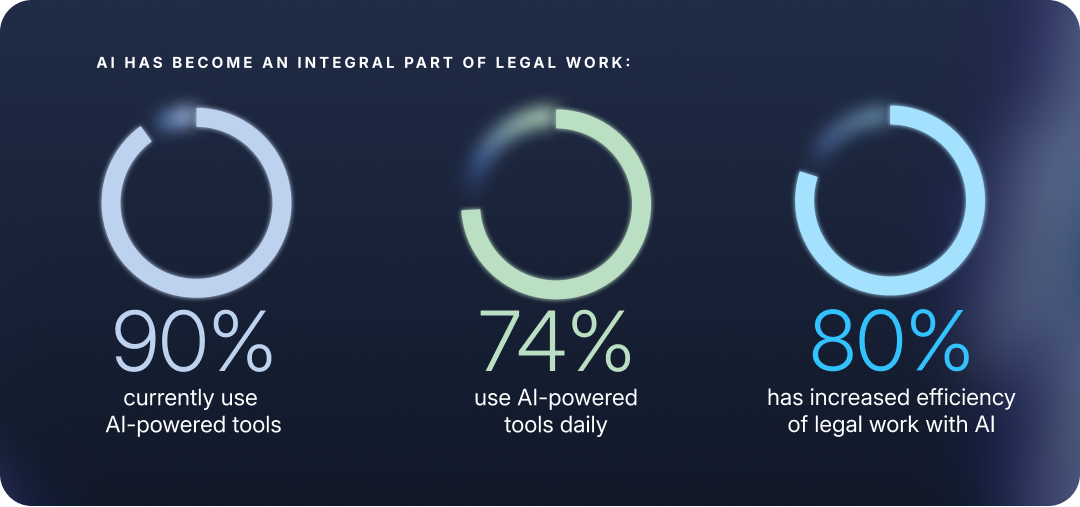
The CosmoLex 2026 Legal Tech Report shows how quickly AI has become an integral part of legal work:
- 90% of surveyed firms use AI-powered tools.
- 74% use AI every day.
- 80% say AI has increased the efficiency of their legal work.
We know firms are adopting and using AI at an unprecedented rate. But is it actually reducing work for legal professionals, or is it simply adding an extra app to manage?
That answer is starting to come into focus.
General-purpose AI has already proven useful for discrete legal tasks like research and drafting. But the next phase appears to be AI moving closer to the workflows that actually run the firm.
And as AI moves deeper into the practice, more solo and small firms are signaling the same thing: They don’t want more tools. They want the tools they have to do more.
What AI Tools Are Firms Using in 2026?
- Claude: 40%
- ChatGPT: 32%
- Copilot: 20%
- More than one: 58%
Generative AI tools like these have become an easy-to-access, common entry point for surveyed solo and small law firms.
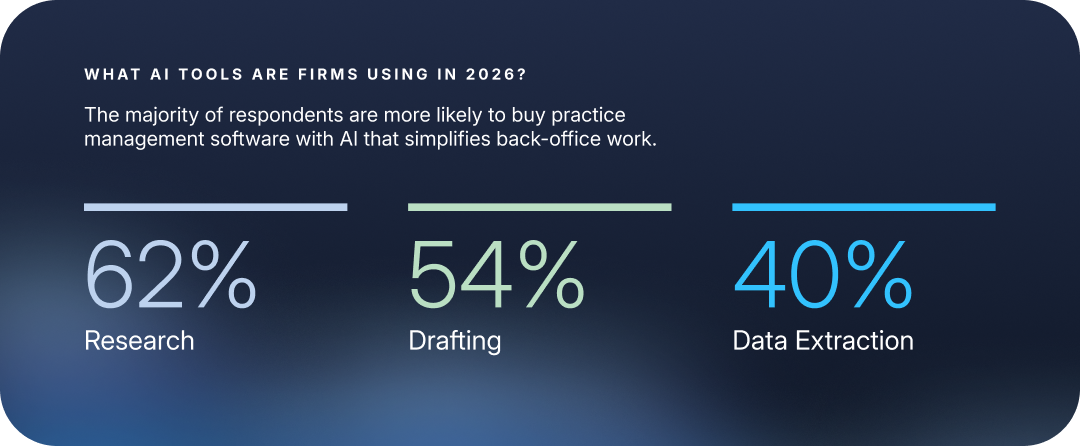
The CosmoLex 2026 Legal Tech Report found that respondents most often use them for research (62%), drafting (54%), and data extraction (40%), and many are seeing efficiency gains.
But in an industry where confidentiality is critical and errors can invite serious repercussions, some surveyed firms worry about accuracy and data privacy.
“We use it regularly to draft, review, and summarize documents, but we are very concerned about confidentiality and how much we can trust its output.”
How Small Firms Are Using AI and Legal Tech Today
We asked 50 legal professionals what they use, trust, and think about as legal tech and AI take on a bigger role in the firm. Here’s what they told us.
Firms Are Already Dealing with Tool Sprawl
With general-purpose tools that sit outside the software firms already use, each new AI product can add another system to manage.
That can be challenging for firms when 60% of those surveyed currently use four or more systems to manage a single matter from start to finish.
And although many respondents are switching between multiple tools today, 62% rated having a single, consolidated platform for legal work is essential or very important.
That gap highlights a growing tension between the fragmented software stack many firms have today and the one-platform environment they want.
The Real AI Opportunity Is Back-Office Work
The CosmoLex 2026 Legal Tech Report found that back-office work is where many respondents want AI to become more useful. Participants see some of AI’s greatest future potential in client communications (32%), client intake (28%), and conflict checks (24%).
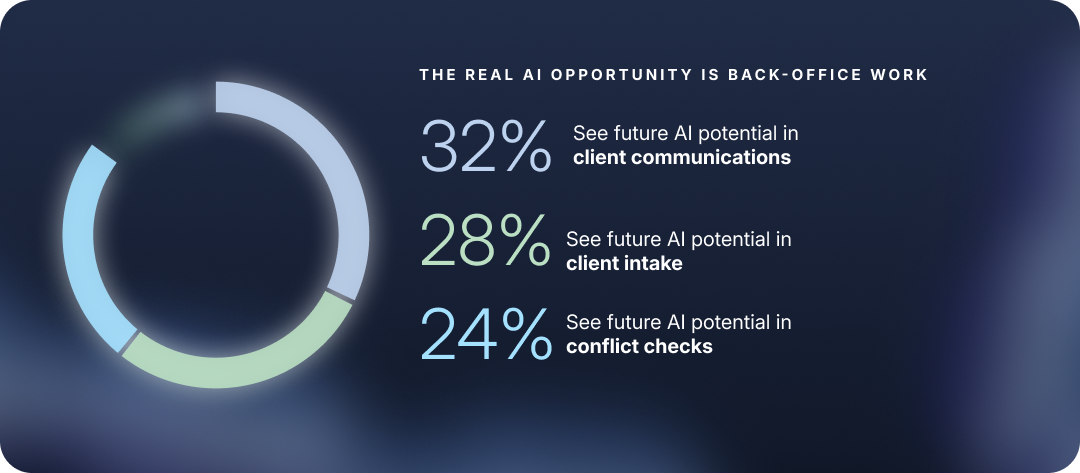
That suggests firms are beginning to look at AI less as a research assistant and more as an operational assistant inside core legal workflows. But the findings also show firms being selective about where and how they want to use it.
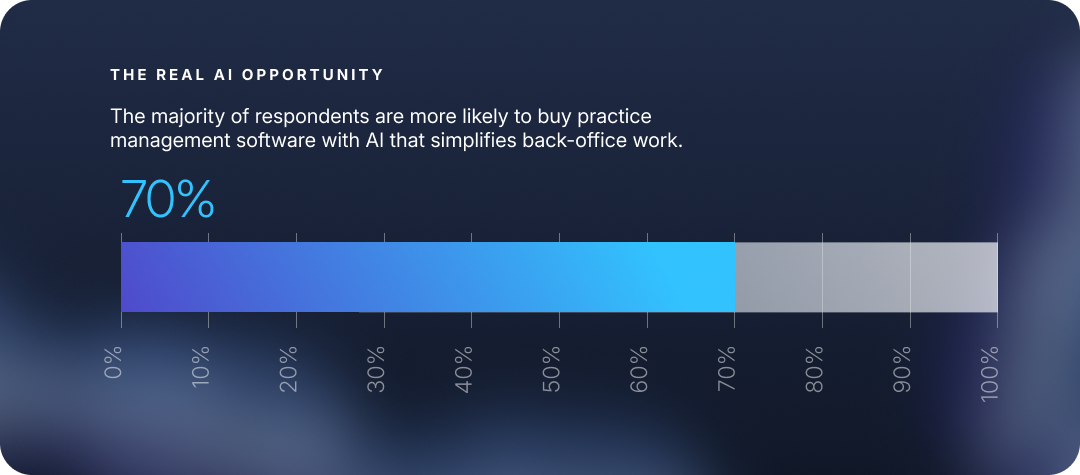
In the report, 70% of respondents said they are more likely to buy practice management software with AI that simplifies back-office work—tasks that actually help matters move forward.
For some, the value of making AI part of practice management is in reducing manual effort and errors. One respondent noted, “Automated data transfer eliminates the potential risk of human error associated with reentering information.”
Others said they would like AI to eliminate specific tasks altogether, including calendaring and timekeeping, data entry, and drafting correspondence.
Taken with the 62% of participants who say a consolidated platform is essential or very important, these perspectives help explain why some respondents would rather add AI to software they already use than adopt another standalone product.
Embedded AI Emerges as a Better Fit for Solo and Small Firms
One respondent explained it this way: “We have figured out the products we use and are very unlikely to change as long as they do their job, so we’re interested in an add-on to that existing platform rather than switching to another AI product.”
Firms may see embedded AI as a better fit than a standalone tool because:
- It works closer to the data, workflows, and records already inside the firm’s practice management platform.
- It can reduce the need to re-enter, copy, and paste information between separate tools.
- It operates inside a familiar, secure environment the firm has already vetted.
- It can support more of the back-office work respondents want AI to simplify, like client intake and document management.
Some respondents see built-in AI as a standard expectation for practice management software. One said, “So much AI is available that it wouldn’t be a selling feature; it would be discouraging if it lacked AI capabilities.”
What Useful AI Looks Like in Practice
The data does not suggest that firms want AI in every process and workflow. It does suggest that participants want AI where it removes work without creating new friction, and there is growing interest in bringing that technology into practice management.
So what does that look like for solo and small firms? AI-powered legal practice management should be able to use the data and information already inside the system, support routine legal workflows, and operate within clear security and data-handling boundaries.
CosmoLex is one example of an end-to-end practice management platform with that AI functionality built in.
With integrated AI tools that summarize long documents, create intake forms, and search data and files to find key information quickly, firms can bring AI into the work they already do without adding a disconnected system to the process.
That’s the difference between adding a separate AI tool and building legal-specific AI into the platform that already runs the firm.
The Future of Legal AI Is Built In, Not Bolted On
The CosmoLex 2026 Legal Tech Report found that AI already has a place in the practice, but firms want it to fit the way legal work already gets done.
 CosmoLex 2026 Legal Tech Report” class=”wp-image-53391″/>
That points toward a more consolidated approach to legal technology: one practice management platform where matters, billing, accounting, and AI work together.
The real value of embedded AI isn’t just what it brings to the practice, but what it takes away. For a solo or small firm, that may look like fewer manual steps, less time spent moving information between tools, and less administrative work pulling staff away from clients.
What would it look like to get more AI support without adding more tools? Book a demo now to see how CosmoLex brings AI into an end-to-end practice management system.


