
Alternative Fee Arrangements:
A Practical Guide for Law Firms Ready to Move Beyond Hourly


A matter that used to take 10 hours might take six today.
Your systems are faster, your workflows are more efficient, and AI may help with more of the preparation. But when you bill by the hour, that newfound efficiency can mean billing less for delivering the same value.
That’s one reason law firms are taking a closer look at alternative fee arrangements. Flat fees, subscriptions, contingency fees, capped hourly arrangements, and hybrid models can give clients more cost certainty.
Just as importantly, they can give your firm more flexibility in pricing. But first, you need to know what each arrangement actually costs to deliver.
This guide compares the most common alternative fee arrangements, where each one fits best, and how to price and track them so you can experiment without putting profitability at risk.
Alternative Fee Arrangements at a Glance
Moving beyond hourly billing doesn’t have to mean abandoning the concept of billable hours. Alternative fee arrangements can give your firm more ways to match the price charged to the value or work performed.
What are alternative fee arrangements? They refer to any pricing structure that does not rely solely on billing clients for each hour worked.
Some of the most common arrangements include:
- Flat fees: Charging a flat fee for one predictable service, like an estate plan or will
- Retainers or subscriptions: Offering ongoing access to specific services for a recurring set price
- Capped hourly fees: Billing by the hour up to an agreed maximum amount
- Contingency fees: Collecting a fee only when a specific outcome is achieved
- Hybrid: Combining two or more models when one structure alone doesn’t fit
Some offer firms more flexibility. Some make costs more predictable for clients, and some work best in combination.
The 5 Main Alternative Fee Arrangements for Law Firms
The right fit depends on the matter, the client, and how confidently your firm can estimate the amount of work involved. Let’s take a closer look at how each pricing model can work in a small law firm.
1. Flat Fees
A flat fee pricing arrangement sets one price for a defined matter or scope of work, regardless of how many hours it ultimately takes to complete.
This billing model works best when your firm has handled enough similar matters to accurately estimate the workload. Estate plans, uncontested divorces, immigration filings, and business formations are common examples.
- For clients: More predictable costs upfront
- For firms: More pricing flexibility, but increased risk if matters go over scope
2. Retainers or Subscriptions
A subscription or retainer arrangement gives the client ongoing access to specific legal services for a set recurring fee. This model can work well for business clients that need regular guidance, contract review, or other legal support throughout the year.
- For clients: More predictable legal budget; easier access to counsel
- For firms: More recurring revenue, if scope and usage limits are clearly defined
3. Capped Hourly Fees
A capped hourly fee arrangement keeps the hourly billing model in place, but puts a ceiling on what the client will pay for a defined matter or phase of work.
The firm still tracks and bills time normally, but once the agreed cap is reached, those hours are no longer billed to the client. This can work well when the amount of work is difficult to predict upfront, but the client still wants some protection from an open-ended bill.
- For clients: More cost certainty with a clearly defined maximum
- For firms: Familiar hourly structure, but increased risk of work exceeding estimated scope
4. Contingency Fees
Under a contingency fee arrangement, the fee depends on achieving a defined outcome—usually a recovery for the client.
This model is most commonly used in personal injury law and other eligible matters. Typically, the fee is calculated as an agreed percentage of the recovery.
- For clients: Less or no lawyer fee due upfront, depending on agreement
- For firms: Higher financial risk because payment depends on the result and may be delayed if achieved
5. Hybrid Fee Arrangements
Hybrid arrangements combine two or more pricing models. They are most useful when one model alone does not fit a firm’s full range of legal services or matter types.
Firms may find a hybrid arrangement helpful when part of the work is predictable, like preparing a standard estate plan, but another part is not, like handling unexpected revisions or additional negotiations.
Fee arrangements may be combined in various ways, including these examples:
- Flat fee + hourly overflow: $2,500 for a standard estate plan, then hourly billing for negotiations or revisions beyond scope
- Contingency fee + expenses: Attorney fee tied to recovery, with permitted case expenses handled separately
- Subscription + usage cap: $500/month for up to a defined amount of business-law support, then hourly billing beyond the cap
Find the Right Alternative Fee Arrangement for Your Firm
The best fee arrangement depends on how predictable the work is, how much the scope may change, and what kind of cost certainty the client needs.
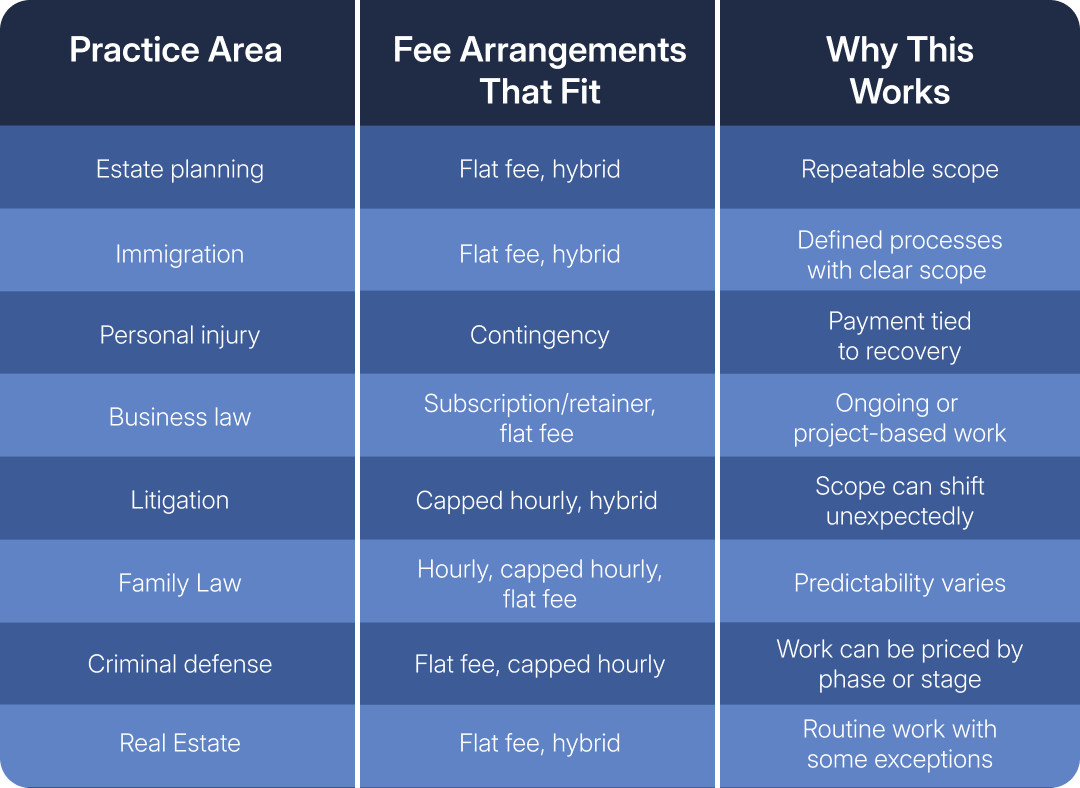
Start with the Matters You Know Best
The safest place to test an alternative fee arrangement is usually a matter type your firm has the most experience with in terms of scope, time, and exceptions.
Start with work that is reasonably repeatable, then pilot the new fee arrangement before you standardize and roll it out on a broader scale.
Price From Your Own Data
Some pricing structures, like flat fees, work best when you know how much time similar matters actually take to complete. Use historical time from comparable matters, look at the average and full range, and build in a reasonable buffer for scope changes.
For example:
8 hours x $300 target rate = $2,400
+ 15% scope buffer = $2,760 flat fee
Keep tracking time even after the fee is set. Continually monitoring your time data helps you calculate the effective hourly rate later and see whether the pricing still works. Review those results by matter type each quarter to see which fees need adjusting.
Handle Advance Flat Fees Carefully
If you collect a flat fee before the work is finished, where that money belongs depends on your state’s rules and when the fee is considered earned.
Some advance fees may need to stay in trust until earned, while other jurisdictions handle them differently.
Clarify the payment terms in your engagement letter, and check your state bar rules before deciding whether an advance flat fee goes into a trust or operating account.
Keep Fee Arrangements Compliant
No matter which fee model you use, keep the ABA Model Rule 1.5 in mind. It requires fees to be reasonable and outlines specific guidance for contingency fees.
Contingency fees are prohibited in all criminal matters and most matters regarding domestic relations, and they must be agreed to in writing. Your state bar association may impose its own rules or requirements around alternative fee arrangements.
5 Ways to Improve Profitability with Lean Workflows
Where firm profitability actually comes from once the billable hour stops being the only lever.
Get the GuideDefine Scope and Terms Upfront
Moving to an alternative fee arrangement or hybrid model requires clear communication with clients. Make sure each affected client understands exactly what the price covers before work begins.
When presenting a new arrangement to clients, focus on what they gain from it. Conversations about predictable costs and a clearly defined scope are more productive than positioning the fee as a “discount” or improvement from hourly billing.
Then use the engagement letter to define:
- What’s included in the fee
- What falls outside the agreed scope
- What triggers additional charges
- How additional work will be billed
- When payment is due
That clarity is designed to protect both sides. The client knows what the fee covers and what costs extra, and your firm has something concrete to point to if the matter expands beyond the original scope.
Here’s a look at sample engagement letter language using a flat-fee example:
“Your flat fee of $______ covers _______. Work outside this scope, including _______, will be billed at a rate of $_______ per hour or priced separately before additional work begins.”
Make Alternative Fees Easier to Manage in CosmoLex
The fee you quote a client is only the starting point. Does the matter still make financial sense once the work is done?
That’s what CosmoLex can help you answer.
Set up different billing arrangements while still tracking the time and expenses behind each matter. Because that information stays connected to billing, payments, trust, and firm accounting inside one practice management platform, you can see each matter’s profitability and what it took to complete.
That gives you a clearer picture of which fee arrangements are working, where margins are getting squeezed, and what you may need to charge next time.
- Track time across fee models: Record time on hourly, fixed-fee, capped hourly, and contingency matters, even when the client isn’t billed by the hour
- See what the matter really earned: Compare hours worked with fees billed and collected, including effective rates and profitability reporting
- Keep the financial picture together: Review billing, payments, AR, expenses, and matter-level financial activity in one central system
- Manage trust alongside billing: Keep operating and trust funds separated with built-in trust accounting tools and compliance safeguards
Your fee model is only as good as the numbers behind it.
Try CosmoLex free for 10 days to see how your firm can price with better data behind every decision.
Frequently Asked Questions
What is an AFA for law firms?
An alternative fee arrangement (AFA) is any pricing model that does not rely entirely on hourly billing. Common examples are flat fees, subscriptions or retainers, contingency fees, capped hourly fees, and hybrid arrangements.
Which alternative fee arrangement works best?
It depends on the matter and the client’s needs. Predictable work may fit a flat or fixed-fee model, while recovery-based matters may better align with contingency fees where permitted. Capped hourly or hybrid models can help when scope is harder to predict.
Are alternative fee arrangements more profitable than hourly billing?
They can be more profitable for specific types of engagements or matters, but it depends on how accurately you price the work and control scope. Firms should use historical matter and time data to see whether an alternative fee arrangement makes sense from a financial standpoint.
Do I still track time on flat-fee matters?
Yes. It’s important to continue tracking time on flat-fee matters. Time data helps you calculate and monitor your effective hourly rate, compare similar matters, and decide whether future flat fees need to change.
Price the work, then prove it was worth it
CosmoLex tracks time, matter costs and profitability together, so a flat fee can be priced from your own numbers instead of a guess.
Book a Demo

