
AI in Law Firms:
2026 Statistics on Daily Use, Efficiency and Capacity


How many lawyers are actually using AI today, and is it making them more productive?
To answer that, the CosmoLex 2026 Legal Tech Report went directly to 50 professionals working in solo and small law firms across North America. From managing partners to paralegals, participants shared how AI fits into their day-to-day work, where it’s saving time, and where they’re seeing the biggest impact.
The findings show AI becoming a regular part of legal work, but not in one uniform way. Some participants are gaining speed, some are finding more capacity, and others are learning that faster output can create more work to review.
The numbers below show where AI use stands today and what surveyed firms are getting from it.
AI Use Is Already Routine for Most Surveyed Legal Professionals
CosmoLex 2026 Legal Tech Report respondents are frequently using AI-powered tools in their legal work.
- 74% of participants use AI daily
- 90% use AI at least weekly
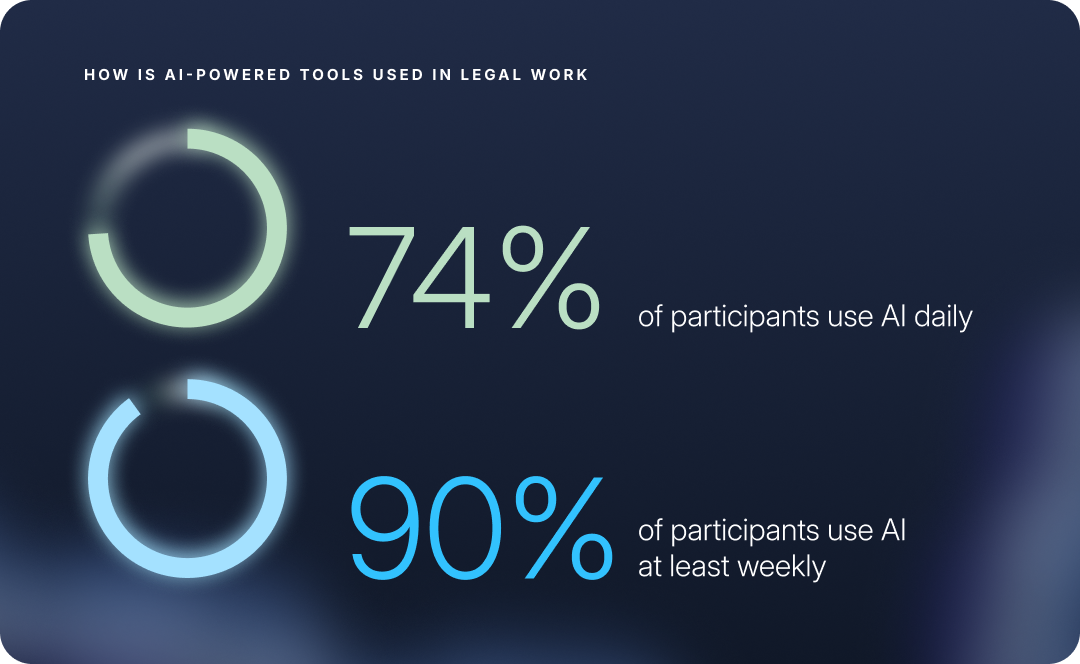
Daily use was the norm for nearly three-quarters of participants, while nine in ten said they use AI tools at least once a week.1
By comparison, a 2025 legal industry report found that 31% of legal professionals said they used generative AI at work.2 The studies measure AI use differently, but they still speak to a larger industry trend taking shape: AI use is becoming more routine than occasional in legal work.
Which AI Tools Are Solo and Small Firms Using?
Frequent or daily AI use does not necessarily mean solo and small firms are relying on a single platform.
Among respondents, 58% said they use more than one AI tool. The most commonly cited platforms in the CosmoLex 2026 Legal Tech Report included Claude (40%), ChatGPT (32%), and Copilot (20%).
With many participants already combining multiple AI tools, what they use those tools for is just as varied.
Top AI Use Cases Among Surveyed Law Firms
The data shows that a majority of surveyed legal professionals have adopted AI and use it frequently, but how does it actually fit into legal work?
The most common AI use cases among participants included:
- Legal research: 62%
- Drafting documents: 54%
- Extracting data: 40%
- Reviewing documents: 40%
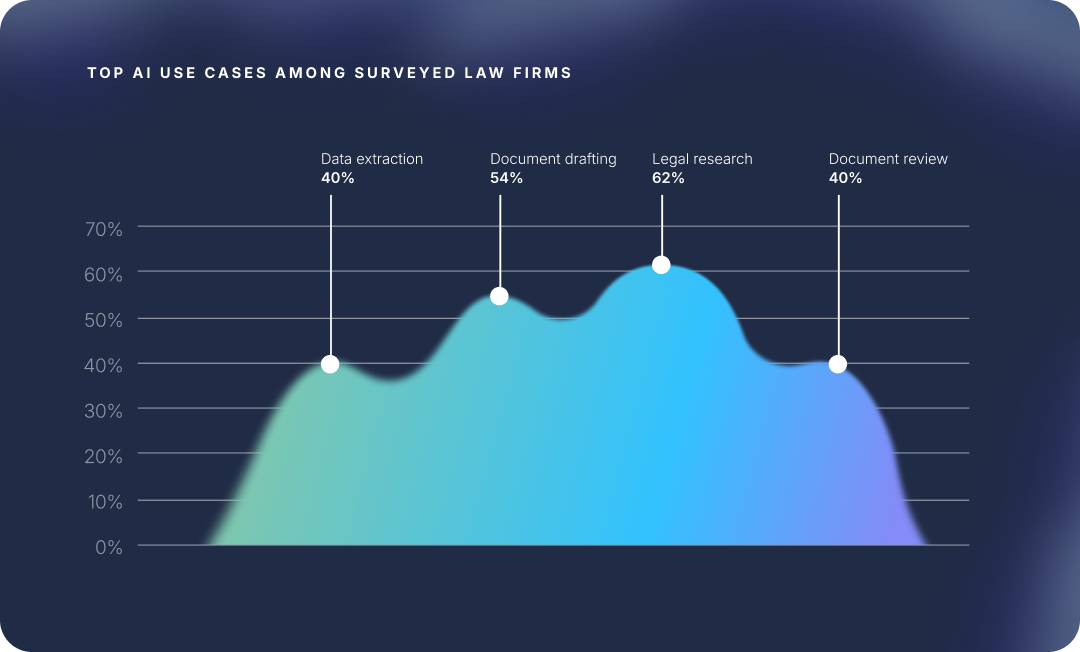
The usage mix shows that respondents are using AI on both sides of legal work: making sense of information that already exists (research, document review, data extraction) and creating something new from it (drafting documents).
What these uses have in common is the volume of data involved. AI is helping legal professionals work through information, whether they are finding it, reviewing it, pulling details from it, or turning it into a draft.
Most Respondents Rate Their AI Skills Average or Better
The CosmoLex 2026 Legal Tech Report also found that adoption and frequent use may not directly translate into expert-level confidence with the technology.
When participants rated their own AI skill level on a five-point scale, most placed themselves in the middle:
- Advanced (5/5): 8%
- Proficient (4/5): 40%
- Average (3/5): 40%
- Below average (2/5): 10%
- No skill (1/5): 2%
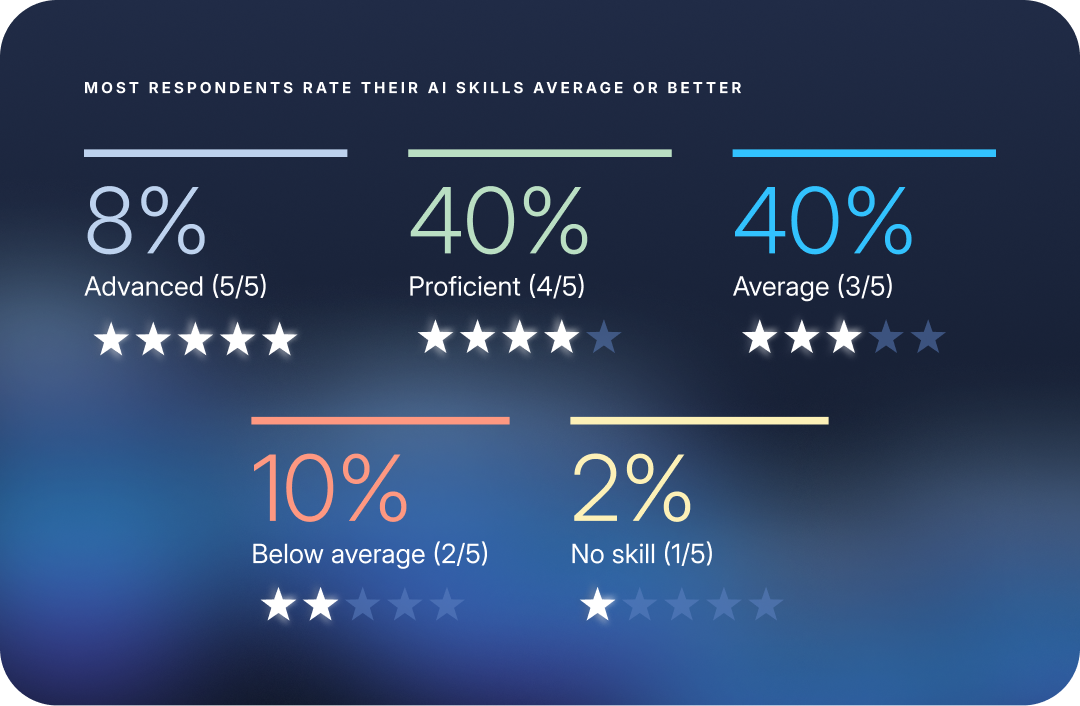
Interestingly, only 12% rated their AI skills as below average or nonexistent, while 88% placed themselves somewhere between average and advanced.
That suggests that most respondents are not approaching AI as complete beginners, even if relatively few consider themselves highly skilled with it.
AI Is Improving Efficiency, With an Important Caveat
When asked if AI has made their legal work more efficient, 80% answered yes. Looking back to the top use cases—research, drafting, data extraction, review—these statistics suggest that legal professionals are gaining efficiency by applying AI tools to tasks that are often information-heavy.
Several respondents described that improvement in concrete terms. One noted, “A sentencing memo used to take me two days, and now it takes an hour.” Another added, “My email response time has been cut in half.”
But a few participants said the faster output and efficiency AI brings is balanced out by an increased need for human review.
As one put it, “It accelerates the work, but it creates other tasks, such as extensive review, so it is not all good or bad.” Another echoed, “Using AI is like training an intern in that you need to check the work.”
While most respondents agreed that AI helped shorten the time it takes to produce a first result, the need to apply judgment, check accuracy, and keep a human in the loop was top of mind for participants.
Saved Time Is Translating into Speed and Capacity
Some respondents in the CosmoLex 2026 Legal Tech Report saw efficiency gains as the ability to complete specific tasks, like sentencing memos or emails, faster. Others have found that saved time is increasing their capacity for legal work overall.
One stated, “Things that once took hours now take minutes, letting me take on more work.”
For a solo or small law firm, those gains can open up the bandwidth needed to support growth. Another said, “If I did not have AI to support me, I am not sure I could have launched my own firm and grown it.”
Recovered time can also help create more room for client interaction and relationship-building. For some respondents, that is where the value of faster work becomes tangible.
One participant described AI’s role this way: “The goal of using AI is for staff to worry less about drafting and reviewing documents and spend the extra time talking to clients, thinking about cases, and visiting with them.”
Where Firms See AI Bringing More Value in the Future
When asked about where they expect AI to become more useful in the future, respondents cited key administrative and communication tasks:
- Communication and chatbots: 32%
- Client intake: 28%
- Conflict checks: 24%
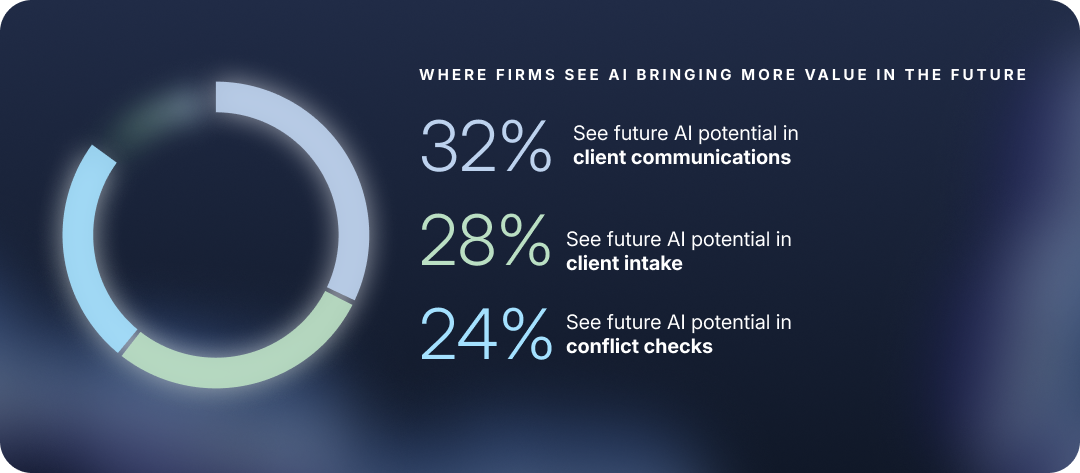
Rather than only focusing on research, drafting, or document-heavy work, respondents see the most potential for AI in workflows that affect how firms communicate with prospects, open new matters, and manage risk.
Administrative Tasks Top the AI Wish List for Respondents
Some of the future value of AI could be in the elimination of specific tasks, according to several participants in the CosmoLex 2026 Legal Tech Report.
When asked which tasks they would most like AI to take over completely, routine administrative work rose to the top:
- Calendaring and time entry: 12%
- Data entry: 10%
- Drafting correspondence: 8%
The findings suggest that legal professionals see value in automating these repetitive, everyday tasks to create more capacity for legal and client-facing work.
See What Else the 2026 Legal Tech Report Reveals
These findings are only part of the picture. The full CosmoLex 2026 Legal Tech Report goes deeper into how solo and small-firm professionals are using AI, where they still see friction, and what they want from legal technology next.
Download the report for the firsthand perspectives behind the numbers, plus a broader look at what changing legal technology really looks like in practice.
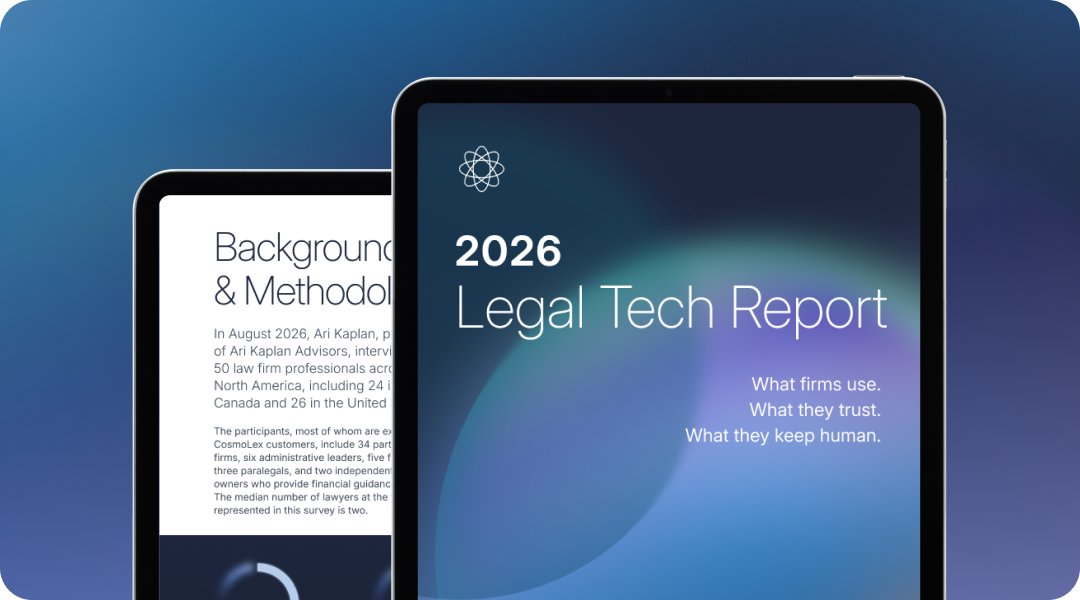
Methodology
The CosmoLex 2026 Legal Tech Report is based on interviews conducted by Ari Kaplan Advisors with 50 legal professionals at solo and small law firms in the United States and Canada in August 2026. Twenty-six participants were based in the United States and 24 in Canada. The median firm size was two lawyers.
Unless otherwise stated, all statistics in this article come from that research and describe the participants surveyed. Percentages should not be interpreted as estimates for the entire legal industry.
How to Cite These Statistics
When citing statistics from this article, please attribute the findings to the CosmoLex 2026 Legal Tech Report.
Suggested citation: CosmoLex 2026 Legal Tech Report, research conducted by Ari Kaplan Advisors, August 2026.
For online articles, reports, newsletters, and other digital publications, please link to this article or the full report when referencing the data.
Sources
1. CosmoLex 2026 Legal Tech Report, https://go.cosmolex.com/guides/cosmolex-legal-tech-report-2026/
2. The Legal Industry Report 2025, https://www.americanbar.org/groups/law_practice/resources/law-technology-today/2025/the-legal-industry-report-2025/


