
2026 Legal Tech Report:
7 Key Takeaways on How Solo and Small Firms Use AI


For solo and small law firms, legal technology decisions are becoming more deliberate. Some of the biggest industry developments, including AI and automation, are increasingly becoming part of the daily routine.
The next question is how legal professionals are actually putting them to work in a small practice.
That comes through clearly in the CosmoLex 2026 Legal Tech Report. AI is central to the story, but the more revealing findings are about what happens after adoption: which tasks firms trust technology with, where they’re seeing measurable gains, and how those choices are affecting the way they run the practice.
Before diving into the full CosmoLex 2026 Legal Tech Report, here are seven takeaways worth paying attention to.
About the Research
The CosmoLex 2026 Legal Tech Report is based on original research commissioned by CosmoLex and conducted by Ari Kaplan Advisors in August 2026. The research includes interviews with 50 legal professionals across North America, including the United States and Canada. The median firm represented had two lawyers.
1. AI Is Already Part of the Practice
Many of the solo and small firms surveyed are already past the experimentation phase with AI and bringing it into daily use.
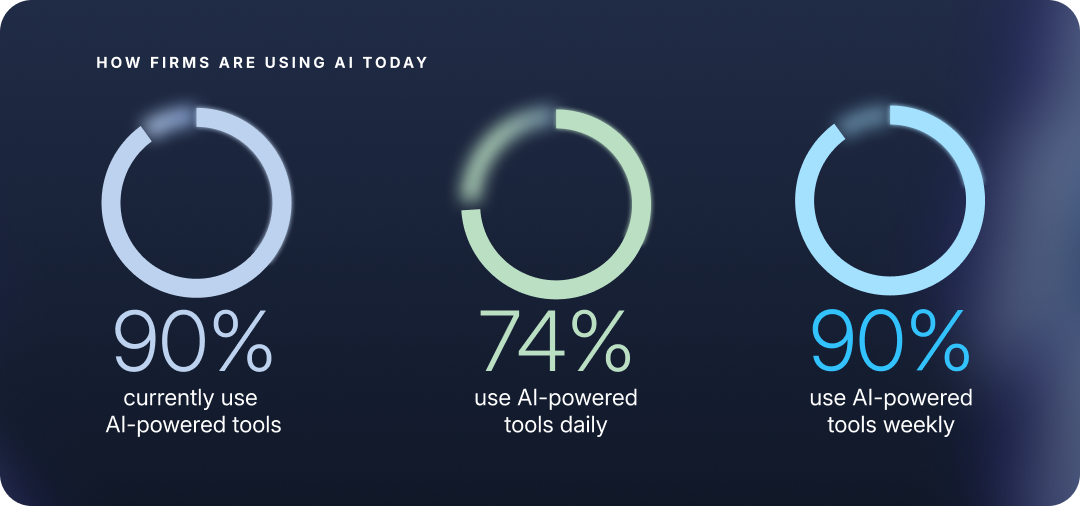
Among respondents, 90% currently use AI-powered tools, 74% use them daily, and 90% use them at least weekly. Availability may have opened the door to AI in small law firms, but responses suggest usefulness is what keeps it in the workflow.
“In the last six months, AI has gone from something I hardly used to something I use daily because I now trust it to be useful.”
For some, AI capabilities have become less of a differentiator and more of an expectation.
“So much AI is available that it wouldn’t be a selling feature; it would be discouraging if it lacked AI capabilities.”
2. Firms Are Using Multiple AI Tools
Nearly 60% of those surveyed say they’re using more than one AI tool. Usage was spread across platforms like Claude (40%), ChatGPT (32%), and Copilot (20%).
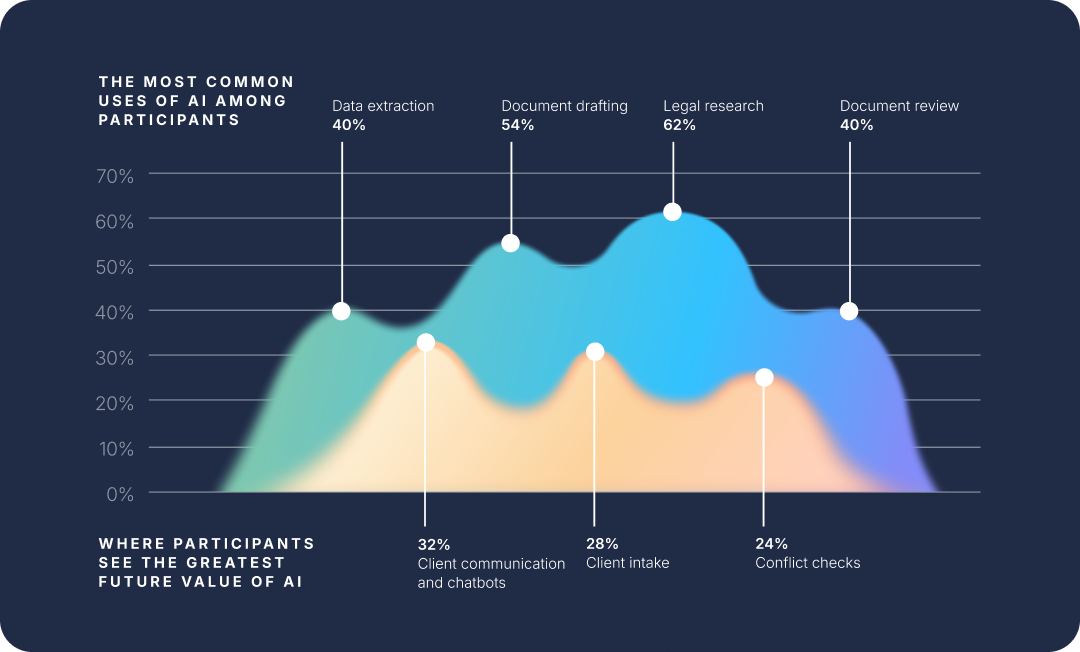
Respondents are predominantly reaching for these general-purpose platforms to help with time-consuming tasks like research, drafting, data extraction, and document review.
“I use it for everything from incorporating it into my email and calendar to drafting; I also have it perform research and red-team analysis on my own work.”
3. Trust, Not Access, Is the Real Adoption Gate
Firms aren’t forgetting about risk and professional responsibility, even when they use AI daily. Some of participants’ top concerns were around accuracy, data security, and compliance.
“Using AI is like training an intern in that you need to check the work.”
Rather than waiting to develop complete trust with AI, solo and small firms are tempering their concerns by carefully reviewing output and making a commitment to personal accountability for the final work.
“AI is still not guaranteed to be accurate…after all, you still need to sign your name to everything you produce.”
4. Efficiency Gains Are Making Room for Growth
For many respondents, the benefit of AI in small law firms is already measurable. Eighty percent say it has increased the efficiency of their legal work.

“Things that once took hours now take minutes, letting me take on more work.”
And for some, that efficiency is creating the space needed to take on more work and expand what a small team is able to handle.
“If I did not have AI to support me, I am not sure I could have launched my own firm and grown it.”
5. Firms Want AI Inside the Systems They Already Use
Respondents want more AI capabilities in legal software, but not necessarily an additional tool to manage. There is an emerging preference for embedded AI that works inside the platforms they already know and trust.
Seventy percent of participants say they’d be more likely to buy practice management software if it included AI that simplifies back-office work. Sixty-two percent also rate having a single, consolidated platform as “essential” or “very important.”
“We have figured out the products we use and are very unlikely to change as long as they do their job, so we’re interested in an add-on to that existing platform rather than switching to another AI product.”
With a growing appetite to simplify core legal technology, solo and small firms may increasingly look for ways to add more capability without adding more complexity.
6. The Automation-to-Human Handoff
Even as technology takes on a bigger role within small practices, legal professionals are still mindful of the moments where a human belongs in the process.
Intake is one example. Roughly a third of respondents already use online forms or automation before the first prospect meeting, and 30% say they’ve experimented with AI intake tools like form builders or chatbots.
Firms see opportunities to use AI-powered tools for forms, data collection, scheduling, follow-ups, and other administrative steps around intake.
“We think using AI during the intake process would make it less frustrating for clients.”
But conversations that depend on understanding nuance, building rapport, and exercising human judgment are treated differently.
“You often ask a client a question, and they answer, but an AI tool typically cannot recognize body language that would prompt a follow-up question.”
Respondents are less interested in using AI and automation to take people out of the process than they are in using it to lead administrative tasks while keeping humans involved where context and relationships matter.
7. Profitability Is Changing Before Pricing
AI-driven time savings are translating into better margins for some surveyed firms, particularly around flat-fee work.
“I have become more profitable by using AI, as it saves time on flat-fee engagements.”
But pricing models are moving much more slowly, with only 14% of participants reporting that AI has directly affected pricing so far.
“AI saves time, so we have probably saved our clients money, but we have not changed the value of an attorney hour or adjusted pricing.”
That gap may be an important development to watch: the economics of doing the work can change before the way firms price that work does.
Get the Full Picture on Legal Tech in 2026
These seven takeaways highlight some of the strongest findings in the research.
The full CosmoLex 2026 Legal Tech Report shows the full range behind them: the firsthand experiences behind the numbers, the concerns and benefits solo and small firms are weighing, and how technology is making a real impact on day-to-day practice.
See the numbers behind the headlines and the candid perspectives that give them context.


